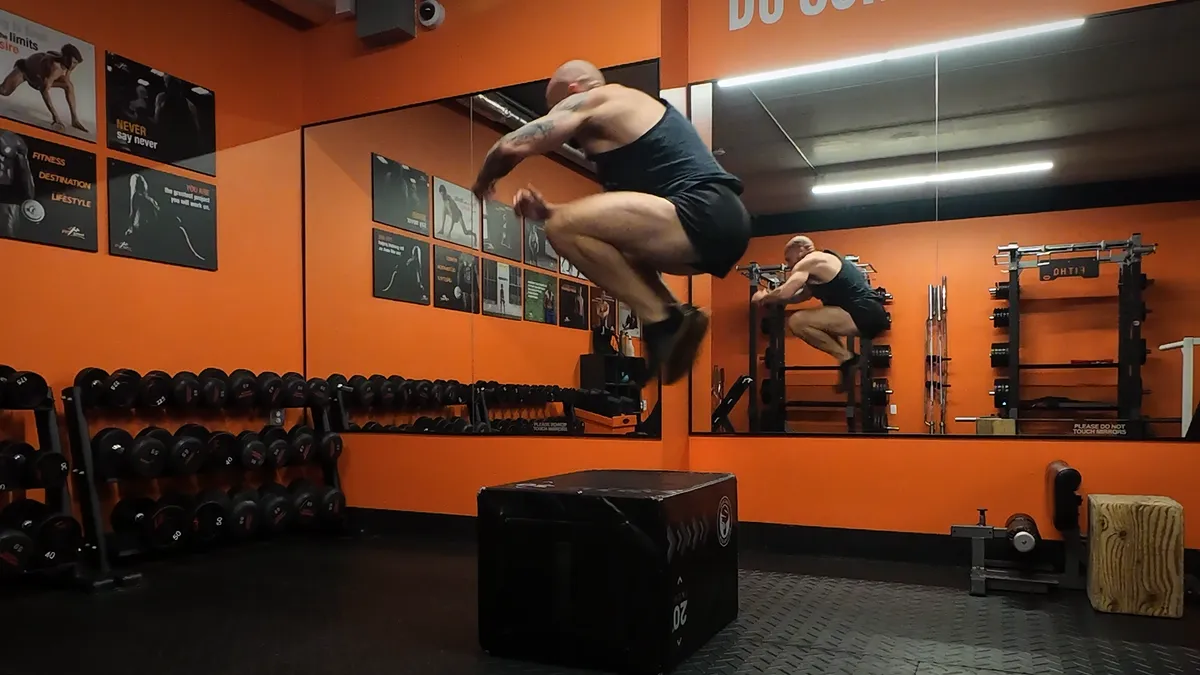
Skies out, thighs out. Box jump day at the gym, and everything here happens on one soft box.
We’ll do six variations, stacked from easiest to hardest. Each one keeps the same basic jump and changes a single thing about it: how you come down, how long you stay on the floor, how many legs you use, or what you do between reps. That is the whole method.
You do not need all six in one session. Pick the one that matches where you are and work it. The last one is what happens when you stop picking and do the lot.
The Six at a Glance
| Variation | What it changes | Trains |
|---|---|---|
| 1. Single Leg Step Up | No jump at all | Warm-up, box confidence |
| 2. Box Jump, Step Down | Full jump up, walk down | Power, Achilles-friendly |
| 3. Plyometric Box Jump | Minimal ground contact | Elastic rebound, speed |
| 4. Box Jump to Jump Over | Jump over, turn, repeat | Agility, direction change |
| 5. Single Leg Box Jump | One leg launches | Stability, balance |
| 6. Burpee to Box Jump | A burpee between reps | Conditioning, grit |
They go in that order for a reason. Each one adds a demand the one before it did not have, so you can stop wherever the movement stops being clean.
As a rule of thumb, own a variation before you move up to the next one. Two sets of ten, with the quality holding all the way to the last rep.
Sets: 2 | Reps: 10 clean, per variation, before progressing
That is a competence gate rather than a training prescription. It tells you when you have earned the next variation, not how much jumping to do in a session. Quality ends the set, not the count. If ten is falling apart by rep seven, seven was your set.
1. Single Leg Step Up
Start here every time. The step up does two jobs at once, and only one of them is warming up the legs.
The other job is finding out how firm the box is. A soft box gives under you, and how much it gives changes how you land on it. Better to learn that with one foot and no airtime than to discover it halfway through a jump.
Drive through the whole foot and stand all the way up at the top. Step back down under control. A few of these on each leg and you know both your legs and the box.
2. Box Jump, Step Down
The standard box jump. Load the hips, swing the arms, and send it.
Step down off the box instead of jumping down. Every rep you jump down is another landing your Achilles has to absorb, and while you are still warming up that is a cost with no benefit. Stepping down keeps all the work on the way up, where you want it.
This is the version most people should spend the most time on. It is not a stepping stone to the fancier ones. It is the exercise.
3. Plyometric Box Jump
Same jump as the last one. The only thing that changes is how long you spend on the floor between reps, and the answer is as little as possible.
That elastic rebound off the floor is what makes you quicker and more explosive. Your tendons store energy when you land and give it back if you go again fast enough. Wait around at the bottom and the energy is gone, and you are just doing box jumps with extra steps.
This is the first version where fatigue gets dangerous. When the ground contact starts getting longer, the set is over. It’s also more dynamic, so be sure to have enough setback distance from the workout area. If your toe catches the box, you’ll want to abort the jump into something other than a stack of dumbbells.
4. Box Jump to Jump Over
Now the box stops being a thing you land on and becomes a thing you get past.
Jump up and unload off the box. Then jump straight over it without stopping. At the far side you do a spinny poo, which is my name for the quick turnaround, and come straight back. The turn is the part people rush and it is where the balance actually gets trained.
This one adds direction change to everything the plyo version already asked for. You are no longer jumping in one plane.
5. Single Leg Box Jump
Back to a plain jump, with half the launching equipment.
Use the full momentum of your upper body to get this one moving. The arm swing matters far more on one leg than on two, because your leg alone will not produce enough to clear a useful box height.
Then stabilise at both ends. The top of the rep and the bottom of the rep both want to throw you sideways, and holding each one still is most of the exercise. Single leg box jumps tax every part of stability and balance you have.
6. Burpee to Box Jump
Why not add burpees to box jumps.
Normal box jump, unload off the box, and at the bottom drop into a burpee as quickly and dynamically as you can. Then straight back up onto the box.
Burpees plus box jumps put a real energy tax on you, and you will be huffing and puffing quickly. This is the variation that stops being a leg exercise and starts being a conditioning one. Your legs are usually not what fails first here.
Leg day in silkies is not a coincidence either. Nothing bunching at the hip when you drop into a burpee, nothing gripping your quad when you drive up onto the box. The one thing you must do with any of this is do it in silkies.
Soffe Original Ranger Panty (Silkies)
The original silkies. Featherweight nylon tricot, 2-inch inseam, brief liner, $18 to $30. My everyday pick for lifting, running, and the river.
Affiliate link — we may earn a commission.Put It All Together
Freestyle. Box jump, drop down into a burpee, jump over the box, spinny poo at the far end, repeat.
I did ten reps of it. It was extremely taxing and I was smoked afterwards. Ten is not a warm up number here. It is the whole finisher.
Sets: 1 | Reps: 10
Footwear earns its place on this one. Every rep has a landing in it, and a flat sole lets you feel the floor and the top of the box. A thick cushioned running shoe squashes under you exactly when you need to know where the ground is.
WHITIN Men’s Cross-Trainer
Cannot Do It Yet
Then do not. The combo is the top of a ladder, not the entry point.
Scale it down and keep the shape. Do a burpee. Step up and step down over the box instead of jumping it. Spin, then burpee again. You get the same sequence and the same lungs without the airtime.
Modify it however you want. Lower the box, cut the reps, walk the transitions, drop the burpee. You can also build in this regression as you train. If the full combo starts deteriorating the form, flip to step ups on to the box and step down. This all depends on how hard you want to push it and your goals.
The only part that is not optional is doing it in Silkies.
If you want a plyometric finisher that needs no box at all, the tuck jump finisher does a similar job on an empty patch of floor.
Frequently Asked Questions
How high should the box be?
Lower than your ego wants. The right height is one you can land on with your feet flat and your chest up, every rep, for the whole set. If you are having to tuck your knees to your chest to clear it, the box is too tall and you are training your hip flexors rather than your legs. If you’re training for true explosive power, that regime uses a higher box with longer rest between reps.
Why step down instead of jumping down?
Jumping down doubles the number of landings your Achilles absorbs, and the down rep trains nothing the up rep did not already train. Step down while you are warming up. If you want the rebound, that is what the plyometric version is for. It rebounds off the floor rather than off the box.
Is a soft box safer than a wooden one?
For shins, yes. A soft box gives when you catch it instead of taking skin off. It also gives when you land on it, which changes the feel, and that is exactly why the first variation here is a step up rather than a jump. Learn the box before you trust it. Test the weight of the box, the one I’m using is dense and didn’t shift about. Some soft boxes are lighter and can tilt if you land on one side.
Are box jumps a leg workout on their own?
They are a power and conditioning workout that uses your legs. The jumping itself builds explosiveness rather than size, and the burpee versions tax your lungs more than your quads. Run them alongside loaded leg work, not instead of it.
What is a spinny poo?
The quick turnaround at the far end of the box before you jump back over. It has a technical name somewhere. This is what I call it.