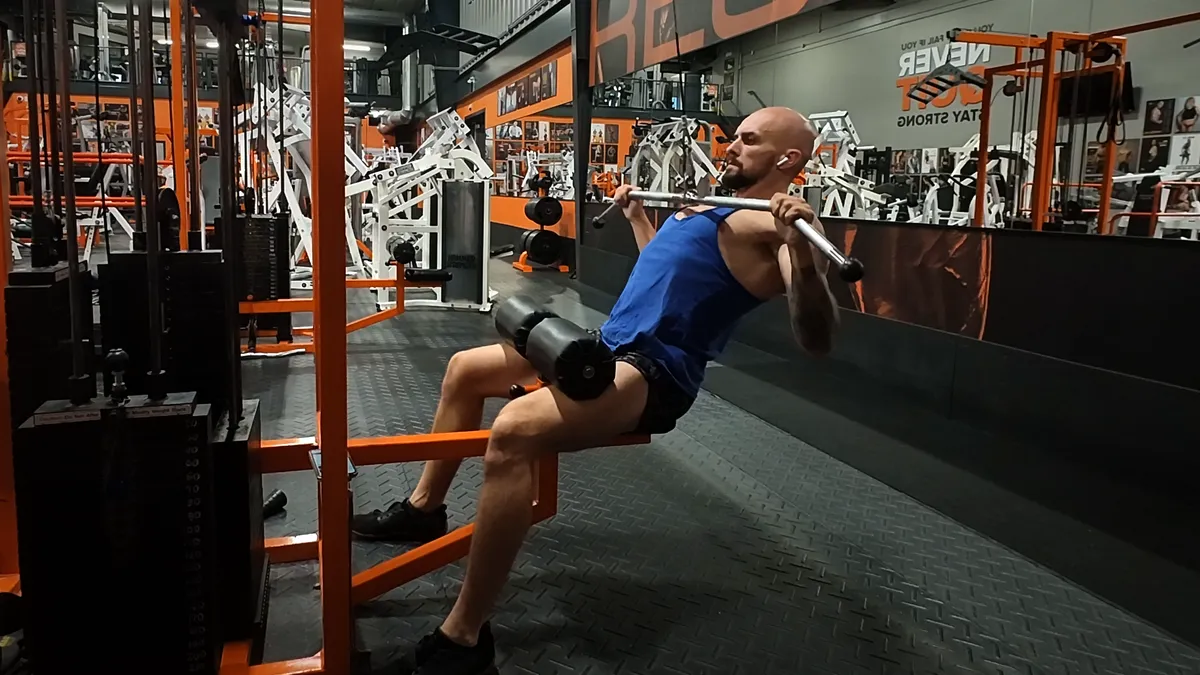
This workout came from a comment on Instagram. A follower requested a workout focused on back, shoulders and arms. Of course Big Papi can oblige when it comes to a lift!
Those three are not a random grouping. Every pull you do for your back already runs through your rear delts and your biceps. They are working whether you planned for it or not. So this session leans into that instead of fighting it. The back gets the big compound work first, while you are fresh. The shoulders and arms get their own direct work after, when they are already warm and primed.
Six moves. Two of them are warm up, and that is not padding. I gave the warm up more than half an hour out of a 90 minute session. There is a reason for that, and I get into it below.
Everything here is standard gym equipment. A bike, a dowel, lat pulldown, a cable stack, one pair of dumbbells, and a bar you can set low.
The Workout at a Glance
| Exercise | Sets | Reps |
|---|---|---|
| Cycle Warm Up | 1 | 15 to 20 min |
| Mobility Routine | 1 | 15 min |
| Lat Pulldown | 3 | 15 / 12 / 8 |
| Rope Face Pull | 3 | 15 / 12 / 10 |
| Dumbbell Curl | 3 | 15 / 12 / 10 |
| Reverse Fly | 3 | 15 / 12 / 10 |
| Inverted Row | 3 | 15 |
The face pull and the curl run as a superset. That is why the six moves come out as seven rows.
Most of the lifts drop the reps and add weight each set. Start at 15 with a weight you can control all the way through. Add load, hit 12. Add load again, hit 8 or 10. The last set should be hard on the last two reps, not on the first two.
The inverted row is the exception. It stays at 15 every set, and it gets harder a different way. More on that at the end.
1. Cycle Warm Up
Fifteen to twenty minutes on the bike, kept light on purpose.
I trained legs the day before, so a hard bike session was off the table. That is exactly why the bike works here. Cycling is low impact and it warms your whole body without beating up legs that already did their work.
I give it fifteen to twenty minutes because I would rather spend the time up front than spend six weeks off with something tweaked. Keep the resistance low enough that you could hold a conversation. If you are breathing hard on the bike, you are burning energy you want for the pulldowns.
2. Mobility Routine
Another fifteen minutes, this time on movement. A dowel is all you need, and a broomstick works just as well.
I run dowel twists and a hip hinge, then hip openers, shoulder rotation work, bend and stretch, and bend and reach. Nothing complicated. It is fifteen minutes of moving every joint you are about to use.
The shoulder rotation work matters most for this session. You are about to ask your shoulders to pull, to fly, and to hold a bar overhead on the pulldown. Getting them through a full range with no weight first means the first working set is not also the first time that joint has moved all day.
Do it in front of a mirror if you have one. You will catch a side that is tighter than the other, and that is worth knowing before you load it.
3. Lat Pulldown
First real lift of the day, and the one that builds width.
A session this equipment heavy lives or dies on what is free when you walk in. Four of these six moves need a specific station, and the usual way it goes wrong is that somebody is parked on one of them. This time the gym was close to empty and I walked straight onto the pulldown. If it is busy when you get there, start on the inverted row and come back. Nothing in this order is sacred except doing the back work while you are fresh.
Set the leg pads tight before you touch the bar. Tight pads and planted feet are what stop you swaying. If you are rocking back and forth to move the stack, the pads are too loose and your lats are getting less of the work than you think.
At the top I extend all the way. Arms straight, lats stretched out long. A lot of people cut this short and start the next rep early, and they lose the whole bottom half of the muscle. The stretch is half the rep.
On the way down, lean back just slightly. Not a yank, not a swing. Just enough to open your chest up toward the bar. I think of it as pushing my chest through the ceiling as the bar comes into my upper chest. Get that image right and your shoulder blades pull down and back on their own.
I run 15, 12 and 8 here because I am chasing some growth. If you are newer to this, keep every set above 12 reps. Lighter weight and more reps give you the room to learn the range of motion and hold your form together while you do it. The load can wait until that part runs on its own.
Sets: 3 | Reps: 15 / 12 / 8
4. Superset: Rope Face Pull into Dumbbell Curls
These two run back to back with no real rest between them. They pair well because neither one takes much away from the other. The face pull is upper back and rear delt. The curl is elbow flexion and nothing else. One is not stealing from the other, so you can keep moving.
Face pulls do not need much weight. Go light and let the position do the work. Set an aggressive staggered stance so you have a base to pull against, because the cable is going to want to drag you forward.
Start with your hands close together on the rope at about chin level, arms extended. Pull. As you pull, separate the two handles so they travel around your head. By the end of the rep the rope should be up at forehead level and your elbows should be wide and behind you. Do it right and the tension sits in your upper back, not your arms.
Straight into the curls. Hold a good core frame and keep your elbows as still as you can manage. The elbow is the hinge, so every bit of it that drifts forward is a rep your biceps did not fully own.
Twist the weight as you curl. Turning your palm up at the top brings the bicep into a fuller contraction, and you will feel the pump land right where you want it. Then control the dumbbell all the way back down. Dropping it wastes half the rep. The lowering half is where a lot of the tension lives.
Sets: 3 | Reps: 15 / 12 / 10 on both
5. Reverse Fly
My favorite shoulder builder, and one that gets skipped constantly.
Rear delts do more for how you look than almost anything else on a shoulder day. They fill out the frame from behind and they pull your shoulders back where they belong. Train them and you stand taller without thinking about it.
Set up with a close footed staggered stance. Close so you stay upright, staggered so you are stable. If your feet are too wide you will lean back to get the weight moving, and the rear delts hand the job to your lower back.
Cross the cables. Right hand takes the left handle and left hand takes the right. Then stand so the cables are pulling slightly toward you with your arms fully extended out in front. That starting tension is the whole point of the setup.
Now drive the handles back and wide without bending your elbows. Locked arms. If your elbows bend you have turned it into a row and the rear delts are off the hook. Play with the tempo and the weight until the position feels natural. Then start adding load.
Sets: 3 | Reps: 15 / 12 / 10
Two staggered stances back to back is a lot of standing and bracing. What I notice most in my WHITIN cross trainers here is plantar awareness. An upright weighted movement on a staggered stance has you making small corrections the whole set, and a flat sole lets you feel them coming up through the floor and answer them. A thick cushioned heel soaks that feedback up before it reaches you, and you end up correcting late.
WHITIN Men’s Cross-Trainer
6. Inverted Row
Bodyweight finisher. Three sets of 15, no weight to add and none needed.
Set a bar in a rack or on a Smith machine so that when you lie down underneath it, the bar is just outside your reach. You want to have to commit to grabbing it.
I bridge my core up into a decline position. Feet planted, knees bent up, hips lifted, arms at about 20 degrees off square. Holding that bridge is half the exercise. Let your hips sag and the whole thing turns into a shrug.
Pull your lower chest toward the bar, not your throat. Pulling high rolls your shoulders forward and takes the mid back out of it.
Because the weight never changes, tempo is your only dial. Pause at the top and hold the contraction. Pause at the bottom and let your forearms cook. Or slow the negative right down, which is the part where you lower yourself back away from the bar. Any one of those turns an easy 15 into a hard 15.
This is also the one move here that survives the gym being closed. Any fixed bar at roughly hip height does the job. A rack at home, a sturdy table edge, a bar laid across two chairs. That is part of why I put it last. If the rest of the week falls apart you can still get this one in on your living room floor.
Sets: 3 | Reps: 15
You are bridged up with your knees driving toward the ceiling for every one of those reps, which is not the moment for shorts that bind at the hip. Short inseam, nothing gripping, nothing bunching underneath you on the floor. Papi does not compromise on this.
Soffe Original Ranger Panty (Silkies)
Making It Harder
On the four lifts with weight, the ladder does the work. Add load as the reps drop and finish the last set close to failing. When 8 stops being hard, the starting weight goes up.
On the inverted row you have no stack to load, so you change the tempo instead. Three seconds down on every rep turns a bodyweight set into a real one. A two second hold at the top does the same thing from the other end. You can also walk your feet further out, which flattens your body and puts more of your weight into the pull.
If you are newer, do the opposite of all of that. Stay above 12 reps on everything. Keep the weight where your form holds together. Add load only once the last rep of a set still looks like the first one, because getting the range of motion right is what the numbers are supposed to be built on.
Frequently Asked Questions
Can you train back, shoulders and arms in the same session?
Yes, and they fit together well. Your back pulls already work the rear delts and biceps, so those two are warm by the time they get direct work. Train the back first with the compound pulls while you are fresh. Then give the shoulders and arms their own moves after. Going the other way around means tired arms limiting how much back work you can do.
How long does this workout take?
About 90 minutes for me, walking in the door to walking out. Thirty to thirty five of that is the bike and the mobility work. The lifting itself is closer to an hour. If you are shorter on time, cut the bike to ten minutes before you cut anything off the mobility.
How much weight should I use for rope face pulls?
Less than you think. Face pulls are a position exercise, not a loading exercise. If you cannot separate the handles around your head and finish with the rope at forehead level, the stack is too heavy. Drop it until the path is clean. Then stay there for a few sessions before you touch the pin again.
Can I do this workout without a cable machine?
Yes, with two swaps. A resistance band anchored at head height covers the face pull, and it trains the same path. For the reverse fly, bend at the hips and do a dumbbell rear delt raise with light weights and locked elbows. The lat pulldown becomes a pull up or a band pulldown, and the rest of the session works as written.
Do I have to do the full 15 minute mobility routine?
Do what you can. Fifteen minutes is what I give it because I would rather warm up too long than sit out an injury. If you only have five, spend them on shoulder rotation, since the shoulders take the most work in this session. What you should not do is load a cold joint and hope.
Want a plan like this, built for your gym?
This is the kind of workout I write for coaching clients. I build the program around your gear and your week. You film your sets. I tell you what to fix.
See coaching options